Why Bangladesh still has load shedding: a household guide
Understand Bangladesh's power capacity, read official load-shedding data, and check whether an outage is a supply shortage, maintenance or a local fault.
When the lights go out, a headline about Bangladesh's power capacity can be puzzling. If the country has so much capacity, why is your fan stopped? The answer depends on how much electricity is available at that moment, whether the network can deliver it, and what is happening on your local connection. A national capacity figure cannot answer all three questions.
Sources checked: 12 October 2026. This AI-assisted article uses dated official records, with a worked example for households.
What Bangladesh's capacity figures actually tell you
The Power Division's snapshot dated 15 September 2026 lists generation capacity of 32,688 MW, including captive power and renewables. It separately lists a highest generation figure of 17,201 MW, recorded on 20 May 2026.
Those figures describe different things and dates. Subtracting the peak figure from the capacity total does not establish how much spare grid supply was available during a particular outage. The snapshot also includes captive capacity, so the headline total should not be read as a promise that all of it can supply household connections at once.
Two units help keep the discussion clear:
- MW or kW measures power: capacity or output at a given time. One megawatt is 1,000 kilowatts.
- MWh or kWh measures energy: power supplied over time. A steady 1 kW load running for one hour uses 1 kWh, commonly called one electricity unit.
The Energy Information Administration explains this capacity–generation distinction. For a bill, you need energy in kWh. For a supply shortage at a particular hour, you need power in MW.
Why available supply can fall short
A plant's capacity stays on the books while its actual output can change. BPDB's report dated 6 October 2026 has separate columns for installed capacity, present capacity, actual output, probable output, fuel-related shortfalls and machines shut down. Reading only the first column misses most of the operating picture.
- Fuel availability: the report marks several gas-fired units as affected by gas shortages. Having a generating unit does not guarantee enough fuel to run it.
- Maintenance and overhaul: the same report identifies units undergoing maintenance or overhaul. Their capacity does not mean they are producing electricity during that work.
- Delivery to the customer: a local interruption has to be checked separately. DPDC publishes distinct service forms for interruptions, load shedding and winter maintenance; these are different operating events.
Also check the column heading: probable generation is a forecast, while actual generation is reported output. Neither a forecast nor a record peak tells you what was supplied to your neighbourhood when its power went off.
How to read an official load-shedding report
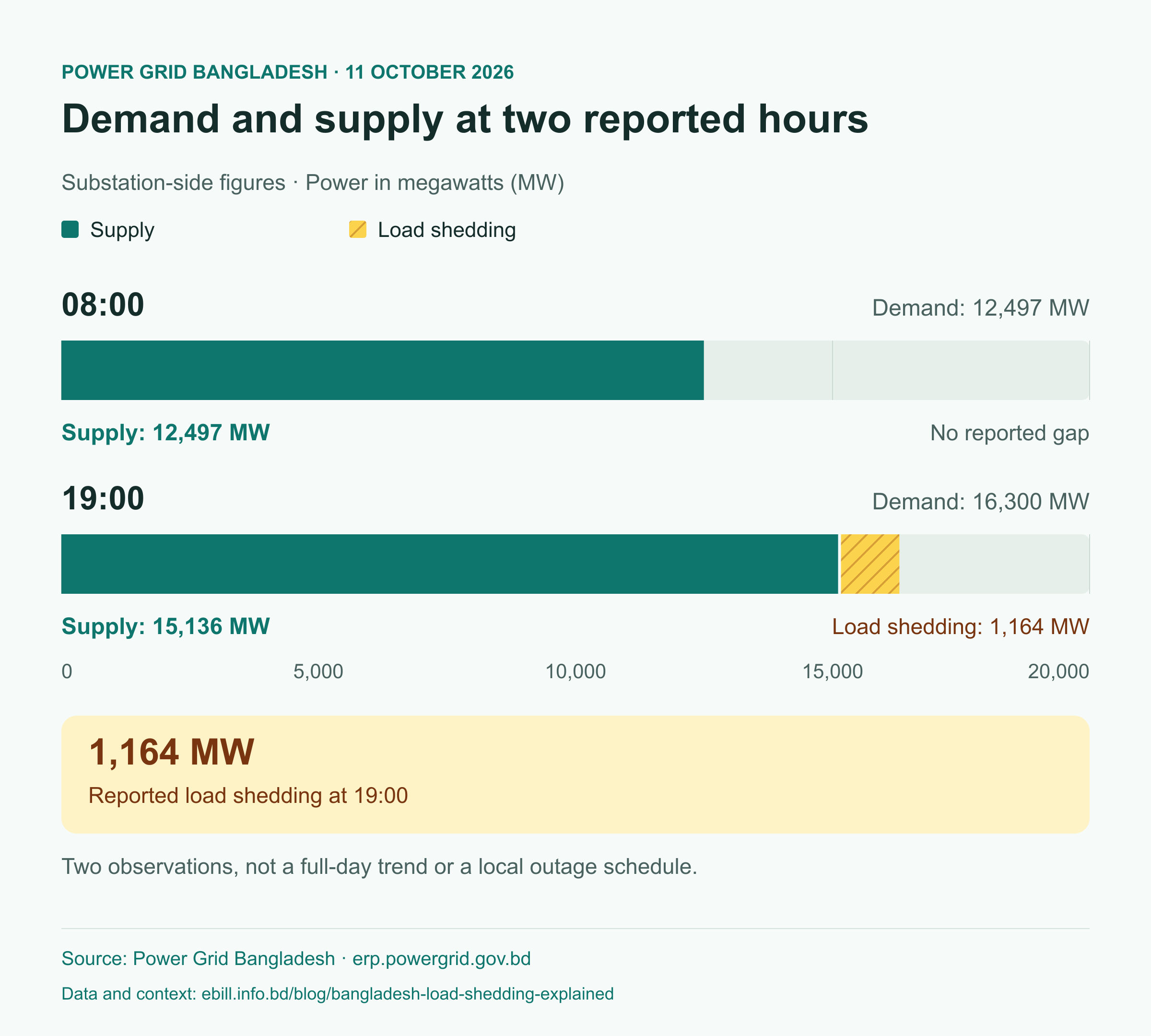
Power Grid Bangladesh publishes demand, supply and load shedding at the substation side. These two entries from its 11 October 2026 report show why the time matters:
Two observations, not a full-day trend or a local outage schedule.
| Time | Demand (MW) | Supply (MW) | Load shedding (MW) |
|---|---|---|---|
| 08:00 | 12,497 | 12,497 | 0 |
| 19:00 | 16,300 | 15,136 | 1,164 |
At 19:00, the reported gap was 16,300 − 15,136 = 1,164 MW, matching the load-shedding entry. At 08:00, reported supply matched demand and the load-shedding entry was zero. This is a comparison of two observations, not a daily average.
A MW figure is not a duration. It cannot tell you that your home will be without power for one hour or three. A national zero also cannot establish that every local line and customer connection is working. Your distributor needs to confirm the cause of a specific interruption.
Before assuming it is load shedding, check these three things
- How far does the outage extend? Ask neighbours and building management whether their grid supply is also off. Check whether they are using backup power before drawing a conclusion. A wider outage suggests a shared supply issue, but does not establish its cause.
- Is there a notice for your location? Look for a dated maintenance or shutdown notice from the distributor named on your bill. Match the area or feeder and the time. A notice for another neighbourhood is not evidence about your own connection.
- Is the problem confined to your premises? If nearby connections have grid power, tell building management or a qualified electrician. A meter message, account issue or wiring fault needs checking; a repeatedly tripping breaker should not be treated as a load-shedding timetable.
Read an accessible meter display without opening its enclosure. Keep away from exposed or fallen wires and report the hazard. The CDC's outage-safety guidance warns against touching fallen power lines.
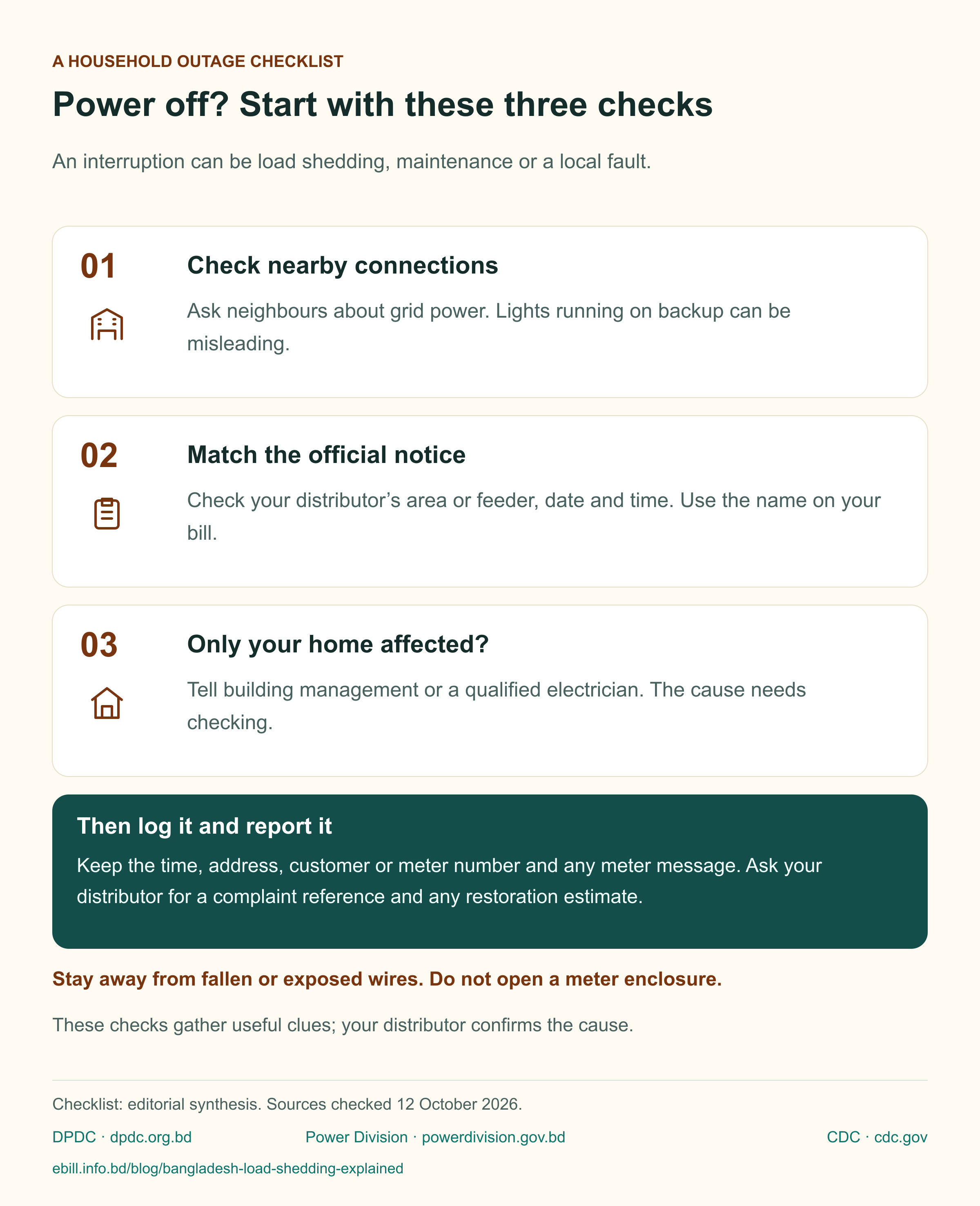
- 01Check nearby connectionsAsk neighbours about grid power. Lights running on backup can be misleading.
- 02Match the official noticeCheck your distributor’s area or feeder, date and time. Use the name on your bill.
- 03Only your home affected?Tell building management or a qualified electrician. The cause needs checking.
Stay away from fallen or exposed wires. Do not open a meter enclosure.
These checks gather useful clues; your distributor confirms the cause.
Checklist: editorial synthesis. Sources checked 12 October 2026.
Keep a short outage log, then contact the right office
Write down when power stopped and returned, your address, customer or meter number, whether neighbours were affected, and any visible meter message. Record the complaint reference and the explanation the office gives. A week of these notes is more useful for describing a recurring problem than a remembered estimate of how often the power goes off.
Complaint template: “Customer number: __. Address: __. Power stopped at __ on __. Nearby grid connections are also off / still on. Meter message, if any: __. Is this load shedding, maintenance or a fault? Please give me a complaint reference and any available restoration estimate.”
Use the distributor printed on your bill. Our distributor guide can help you find its official website. The following numbers were checked against the Power Division's control-room list:
| Distributor | Phone |
|---|---|
| DESCO | 16120 |
| DPDC | 16116 |
| BPDB | 16200 |
| BREB / Palli Bidyut | 16899 |
| NESCO | 16603 |
| WZPDCL | 16117 |
The Power Division also lists 16999as its central complaint hotline. Its guidance is to complain to the relevant distribution office first, then escalate an unresolved complaint to the company's headquarters and the Power Division.
Plan backup power from the appliances you need
Start with essential devices and the duration you want to cover. Here is a hypothetical example, not measured consumption or a forecast of local outages:
- Two fans drawing 60 W each: 120 W.
- Two LED lights drawing 10 W each: 20 W.
- One router drawing 10 W: 10 W.
The assumed load is 150 W, or 0.15 kW. Running it continuously for three hours requires 0.15 × 3 = 0.45 kWh delivered to the appliances. Actual wattages vary. Battery selection must allow for usable capacity and conversion losses; inverter selection must also account for running power and starting loads. The energy calculation alone is not a battery or inverter specification.
Use the appliance calculator with your own wattages. For a fuel-cost comparison, the generator-versus-grid calculatorlets you enter an outage duration and fuel price. Its fuel-use assumptions are estimates, so compare them with your generator's actual consumption and current local prices.
Portable generators need careful siting. CDC guidance says to operate them outdoors, at least 20 feet (about 6 metres) from doors, windows and vents, and use a battery-powered or battery-backup carbon-monoxide detector indoors. Opening a window does not make indoor operation safe.
How this article was prepared
AI assisted with research, drafting and translation, and generated the opening illustration. The chart uses two observations from the official report; the infographic summarizes this article’s outage checklist. The figures were checked against the official sources below; the backup-energy example is calculated from stated assumptions. The aim is to help electricity customers understand an interruption and prepare a useful report to their distributor.
Sources checked on 12 October 2026. Each statistic describes its stated reporting date. Confirm the current situation and any restoration estimate with your distribution office.
- Power Division: power-sector snapshot, 15 September 2026
- U.S. Energy Information Administration: capacity and generation explained
- BPDB: daily electricity generation report, 6 October 2026 (PDF)
- Power Grid Bangladesh: substation-side demand, supply and load shedding, 11 October 2026
- DPDC: service forms for interruptions, load shedding and maintenance
- Power Division: control rooms and complaint contacts
- CDC: electrical and generator safety during a power outage
Related pages
Hotlines & complaints
Who to call for a power cut, a wrong bill, or an emergency — the unified 16999 line, every distributor's own hotline, and the exact escalation ladder when a complaint isn't resolved.
Find my distributor
Pick your district and area type to find which of Bangladesh's six electricity distributors serves you — then jump straight to that company's official hotline, bill portal and apps.
Load shedding cost
Compare what an hour of load shedding actually costs when you switch to a diesel or petrol generator, versus what the same units would have cost on the grid.
Appliance cost calculator
Enter wattage and daily run-hours for any appliance to see exact cost per day and per month at the current Bangladesh tariff. Covers single appliances and full-home loads.